
HeatShield Chimney Sweep in San Marcos: A Homeowner’s Guide
HeatShield is a professional-grade liner resurfacing system that repairs cracked flue tiles and seals joint gaps from inside your chimney, restoring fire safety without tearing out the old liner. It typically costs $80 to $125 per linear foot, which runs noticeably less than a full stainless reline at $150 to $250 per foot. If you’d rather skip the research and get a straight answer about your flue, call (866) 472-2513 and we’ll inspect it for free.
Most homeowners in San Marcos have never heard of HeatShield because most sweep crews here don’t stock it. It’s a specialized product that requires certification, which narrows the field to chimney specialists like us at Oakgrove Chimney Sweep. This guide covers what HeatShield actually does, when it’s the right call, and when an honest contractor will tell you to go with a full liner instead.
Key Takeaways
- HeatShield is a mortar-like sealant applied inside your flue to restore structural integrity and close gaps between clay tiles.
- It’s a middle option between do-nothing and full relining, with real material-science backing, not a big-box caulk.
- San Marcos humidity and hard clay soil make our chimneys prone to vertical stress cracking, which HeatShield handles well when damage is moderate.
- A proper HeatShield job involves camera documentation, mechanical prep, and certification, none of which you’ll get from a crew improvising with off-the-shelf sealant.
- Over five years, HeatShield usually runs 40 to 55 percent less than a full reline while solving the same mid-stage flue damage.
What HeatShield Actually Is (And What It’s Not)
HeatShield is a cerfractory flue sealant, a material blend engineered to expand and contract at roughly the same rate as clay flue tile. That’s the key detail. Generic fireplace caulk and cheap sealants harden into a rigid mass that separates from the tile after a few dozen burn cycles. Your flue heats unevenly, the clay expands, the cheap stuff doesn’t, and you’re back to a cracked flue within two seasons. In our experience across San Marcos, we see this with chimneys in older neighborhoods like Blanco Vista and Hughson Heights, where homes from the 1980s and 1990s are hitting the age when mortar joints start failing.
HeatShield seals those joints and coats the inner flue wall, restoring a smooth continuous surface so heat and combustion gases move up and out instead of seeping through cracks into the chimney structure. It’s not a paint. It’s a bonded layer with enough thickness to bridge gaps up to a quarter inch. When applied correctly, it restores the flue’s gas-tight integrity for years, and the HeatShield warranty reflects that confidence.
What HeatShield Is Not
It’s not a fix for a chimney that has structural damage to the brickwork itself. If your chimney is leaning, has a cracked crown, or shows signs of water intrusion through the masonry, HeatShield won’t repair that. It’s also not the answer for a flue with collapsed tile sections or heavy spalling where large chunks have already broken away. When the damage is that far along, we’ll tell you a DuraFlex stainless liner is the correct call. HeatShield is chartered for liners that are still mostly intact but compromised at the joints and minor cracks.
One thing worth saying plainly: HeatShield is a professional product. It’s not sold at hardware stores in San Marcos, and no general contractor can walk in and buy it without the training. That’s why you won’t find many local crews offering it. We stock it because we’re Chimney Repair in San Marcos specialists, not a seasonal sweep-only operation.
The Damage Profile: When HeatShield Is the Right Call
Every flue tells a story when you put a camera scope up it. Here’s the damage profile where HeatShield earns its keep in San Marcos chimneys:
- Minor to moderate joint erosion: The mortar between clay tiles is flaking or missing in spots, but the tiles themselves are still set and intact.
- Vertical stress cracks: Common in Central Texas clay soil that shifts with drought and floods, causing subtle movement in the chimney stack.
- Light spalling: Surface flaking on tile faces that hasn’t progressed to deep structural loss.
- Gaps up to a quarter inch: Perfect candidate. HeatShield Cerfractory is tested for these openings.
- Secondary flue resurfacing: Chimneys with multiple small flues where a full liner in each isn’t practical.
What lands a chimney in the “full liner” category instead: significant tile displacement where the flue no longer aligns, heavy spalling with large debris fallen to the smoke shelf, or structural damage to the chimney itself. We pulled a full 14-inch tile section out of a fireplace in Trace a few winters ago, not a HeatShield job, that one needed a DuraFlex liner end to end.
The Application Process: What a Legitimate HeatShield Job Looks Like
If you’re going to pay for HeatShield in San Marcos, you should know what a legitimate application involves so you can verify it’s being done correctly. Here’s the sequence we follow on every job:
- 1
Camera inspection and documentation: We scope the flue before anything else. Photos and video give you evidence of the damage and a baseline for comparison.
- 2
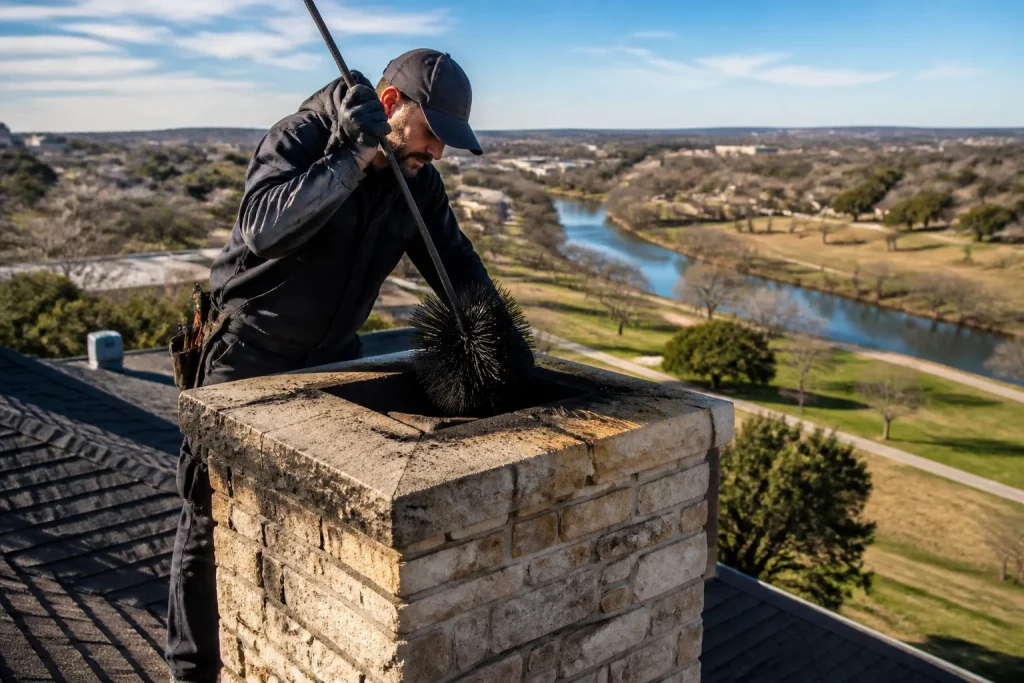
Mechanical cleaning: The flue wall has to be absolutely clean of creosote and debris or the sealant won’t bond. We sweep the chimney thoroughly, wire-brushing the tile surfaces.
- 3
Surface preparation: Any loose or flaking material is removed so the HeatShield layer adheres to solid substrate.
- 4
Application: HeatShield is applied in a controlled, consistent layer over the flue wall. We use a specialized pump to pressurize the material into joint gaps and cracks.
- 5
Cure time: The cerfractory material needs proper cure time before the chimney is used again. We always provide a written schedule.
- 6
Post-application camera verification: We scope the flue again after application to confirm coverage and document the work for your records.
If a crew shows up with a bucket of sealant and a trowel and calls it a HeatShield job, it’s not. Real HeatShield application requires certified training and specialized pumps designed for the material’s consistency. Most San Marcos homeowners will never see the difference unless they get a post-job camera verification. Demand it.
HeatShield vs. Full Relining vs. Doing Nothing: The Real Cost Picture
Here’s what each path actually looks like over five years for a typical single-story San Marcos home with a 20-foot flue:
- HeatShield resurfacing: $80 to $125 per linear foot means roughly $1,600 to $2,500 total. Five-year cost: the same, assuming one application. It’s a permanent repair when the damage profile fits.
- Full DuraFlex stainless relining: $150 to $250 per linear foot, roughly $3,000 to $5,000 total installed. Five-year cost: the same, plus it adds 20+ years of service life and is the right call for severe damage.
- Doing nothing: Free today, but this is the expensive option. A cracked flue allows heat and carbon monoxide to reach the combustible structure around the chimney. The average chimney fire repair we see in Hays County runs $4,000 to $11,000 after the fact, assuming nobody gets hurt. Five-year cost: whatever happens when it fails.
We’ve also seen homeowners pay for a “cheap liner patch” that a handyman applied with hardware store sealant and a prayer. The material failed within a year, the chimney still had the original crack, and they paid twice to fix it the right way. Your flue is a combustion system. If the wrong material fails, the failure happens inside your house, not on your neighbor’s roof.
Why San Marcos Chimneys Need HeatShield Specifically
Central Texas isn’t kind to masonry. We get 90-degree summer days followed by 40-degree winter nights, and that thermal cycling puts stress on every clay tile in the chimney. Add in the drought-to-flood cycles we’ve seen in San Marcos over the last decade, and you get clay soil that expands and contracts like a sponge. The result is micro-movement in chimney foundations, translated upward into the flue.
In established San Marcos neighborhoods with 20- to 40-year-old brick homes, this movement shows up as hairline vertical cracks in the flue tile. They’re small enough that a Level 1 visual inspection might miss them, but a camera scope catches them immediately. That’s the exact profile HeatShield was designed for. And it’s why we recommend a scoped inspection rather than a visual-only check when you schedule your Chimney Sweep in San Marcos. If a crack is present, the camera finds it, and we can repair what we find instead of cleaning and hoping.
One more advantage worth noting: because HeatShield restores the flue wall to a smooth, sealed surface, it also makes subsequent sweeps easier. Creosote and soot have fewer places to stick, which means a cleaner flue between visits, particularly in wood-burning fireplaces in San Marcos that see heavy use from November through February.
Why Most Local Chimney Companies Don’t Offer HeatShield
HeatShield requires a few things most operators don’t want to invest in. First, certified training. The product doesn’t work unless it’s mixed and applied correctly, and HeatShield holds you to their standards. Second, specialized equipment: application pumps, mixing barrels, and proper PPE are not cheap. Third, you need to stock the product, because HeatShield doesn’t sell to just anyone with a truck and a brush. They want proof you’re a legitimate chimney company.
We use professional trade brands across the board: HeatShield for liner restoration, Gelco for chimney caps and covers, and Olympia Chimney components for venting. Those are the same suppliers chimney contractors across the country rely on. When you call a company that stocks this supply chain, you’re getting a different process than one that improvises with whatever the hardware store carries. The difference matters because your chimney runs a high-heat combustion system through the center of your house.
When to Call a Pro
If your chimney is 20 or more years old and you’ve never had a camera inspection, that’s the first call. Signs that something’s already wrong: white staining on the exterior brick, a draft smell even when the damper is closed, flaky tile bits falling into the firebox, or visible cracks in the flue when you look up from below. Any one of those is reason enough to have us scope the flue and assess whether HeatShield resurfacing fits your chimney.
We also see dryers routed through chimneys or into former chimney chases in older San Marcos homes. Different system, same principle: a combustion pathway that’s supposed to move hot air and gas safely out of the house. If your dryer vent hasn’t been cleaned in years, that lint buildup is a fire risk. We handle Dryer Vent Cleaning in San Marcos too, and we treat it with the same inspection protocol we use on chimneys.
The Bottom Line
HeatShield is the repair most San Marcos homeowners never hear about, because it sits between two options they already know: the $200 sweep and the $4,000 reline. When your flue has joint cracks and moderate tile damage, it’s the right fix at the right price, applied by a certified chimney specialist who can show you the damage on camera before and after. When damage is severe, we’ll tell you to go with a full stainless liner, and we’ll show you why on the scope footage.
If you’re in San Marcos and want a straight answer about your flue, Oakgrove Chimney Sweep offers free estimates with camera documentation. We’ll show you what’s going on inside your chimney and tell you honestly whether HeatShield, a full reline, or a routine sweep is what you need. Call (866) 472-2513.
Frequently Asked Questions
HeatShield flue resurfacing in San Marcos typically runs $80 to $125 per linear foot, so a standard 20-foot residential flue lands between $1,600 and $2,500. Your actual cost depends on flue size, damage extent, and whether repairs are needed in multiple flues. Call (866) 472-2513 for a free scoped estimate specific to your chimney.
Yes. HeatShield is engineered for wood-burning flues and restores the gas-tight barrier that keeps heat and combustion byproducts inside the flue where they belong. It’s tested for the high-temperature environment inside a chimney and bonds to clay tile with the same expansion coefficient, so it won’t separate during normal burn cycles in San Marcos homes.
A properly applied HeatShield resurfacing carries a manufacturer-backed warranty and lasts for many years under normal use. We’ve seen properly done applications hold up through a decade of seasonal burning. The factor that determines longevity is the same as any masonry repair: the underlying chimney structure must be sound before the product is applied.
It depends on what the camera shows. If your flue tiles are intact but have joint gaps, hairline cracks, or light surface spalling, HeatShield is likely the right fix and will save you thousands compared to a full stainless reline. If tiles are displaced, heavily spalled, or the flue has structural damage behind it, a DuraFlex liner is the correct call. We’ll show you the scope footage either way. Call (866) 472-2513 for a free inspection.
Written by the team at Oakgrove Chimney Sweep, serving San Marcos since 2017.
Need Chimney Cleaning Help?
Call Oakgrove Chimney Sweep — licensed & insured, here with fast after-hours help in San Marcos.
(866) 472-2513